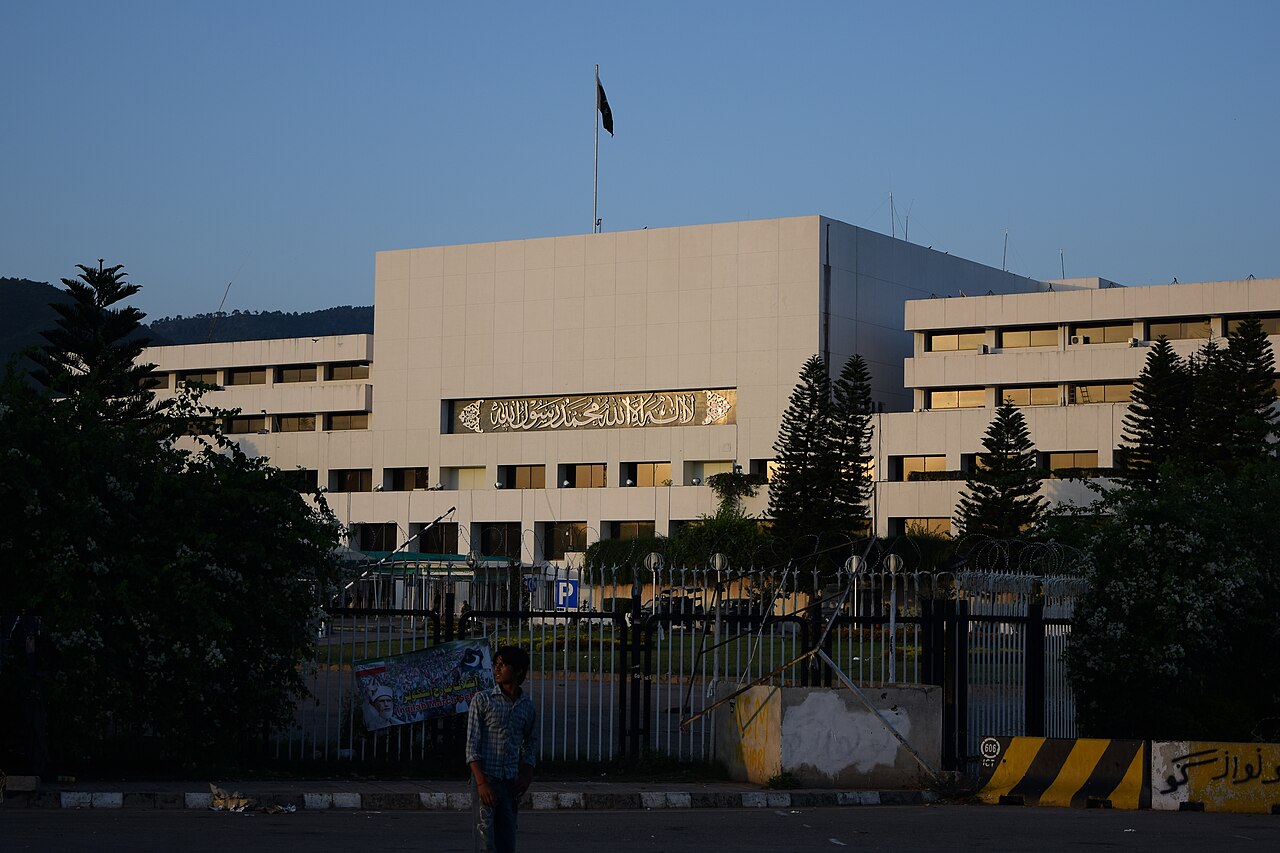
Constitutional basis
The amendment procedure is set out in Articles 238 and 239. Parliament may amend the Constitution through a bill passed with the constitutionally required supermajorities.
Basic procedure
- A Constitution Amendment Bill may originate in either House.
- It must be passed by not less than two-thirds of the total membership of that House.
- It then goes to the other House, where the same two-thirds-of-total-membership threshold applies.
- If an amendment alters the limits of a province, additional approval by the affected Provincial Assembly is required under the constitutional rule.
- After passage, the bill is presented for assent in accordance with the Constitution.
Why “total membership” matters
The threshold is not two-thirds of members present and voting. Absences effectively make the target harder to reach because the denominator is the total membership of the House.
Evaluation points
- Broad consensus can protect constitutional stability.
- Large coalitions may still amend rapidly, limiting public scrutiny.
- Judicial interpretation affects the relationship between amendment power and constitutional structure.
- The quality of consultation matters alongside formal numerical compliance.
Sources and further reading
Last reviewed: 17 October 2026. If you spot an error, please use our corrections process.
Meaning
Federalism divides authority between a national government and constitutionally recognized provincial governments. In Pakistan, federalism is shaped by representation, legislative lists, finance, intergovernmental institutions and the political history of centre–province relations.
Constitutional features
- Bicameral Parliament with the Senate representing federating units.
- Federal and provincial executive and legislative institutions.
- Council of Common Interests for specified shared matters.
- National Finance Commission for distribution of revenues.
- Provincial autonomy strengthened substantially by the Eighteenth Amendment.
- Local government established by provincial law under Article 140A.
Continuing challenges
- Fiscal dependence and revenue capacity.
- Implementation of devolved responsibilities.
- Natural-resource distribution.
- Coordination during health, climate and security emergencies.
- Uneven local-government continuity.
- Balancing national standards with provincial autonomy.
Balanced conclusion
Pakistan’s federal debate is not simply centre versus provinces. Effective federalism needs clear assignments, adequate finance, representative institutions, dispute-resolution mechanisms and routine cooperation across governments.
Sources and further reading
Last reviewed: 17 October 2026. If you spot an error, please use our corrections process.
Definition
Majlis-e-Shoora (Parliament) consists of the President and two Houses: the National Assembly and the Senate. The two chambers represent different principles—population and the federal units.
National Assembly
- Members on general seats are directly elected from territorial constituencies.
- It determines who becomes prime minister.
- Money Bills originate in the National Assembly under the special constitutional procedure.
- Its term and dissolution are governed by the Constitution.
Senate
- Provides representation to the federating units.
- Is a continuing chamber rather than one dissolved as a whole.
- Participates in ordinary federal legislation and constitutional amendment.
- Has a limited role in the Money Bill process compared with the National Assembly.
Core functions
- Legislation
- Budget and taxation
- Executive accountability
- Representation
- Constitutional amendment
- Public debate and committee scrutiny
Analytical issues
- Party discipline versus legislative independence.
- Committee capacity and research support.
- Ordinances and executive dominance.
- Representation of women, minorities and smaller provinces.
- Continuity of sittings and effective accountability.
Sources and further reading
Last reviewed: 17 October 2026. If you spot an error, please use our corrections process.
First-past-the-post
For a general constituency seat, the candidate with the most valid votes wins. Because a majority is not required, a candidate may win while most voters supported other candidates. National vote share therefore does not translate proportionally into general seats.
Why geography matters
Votes concentrated efficiently in winnable constituencies can produce more seats than a similar number spread thinly across the country. Regional strength, alliances and candidate selection are therefore decisive.
Reserved seats
The Constitution reserves representation for women and non-Muslims. These seats are allocated through party lists and formulas linked to party performance, not through a separate direct vote for each reserved-seat member.
Coalition formation
If no party commands the required National Assembly majority, parties and independents negotiate support. The largest party is not automatically guaranteed government; the decisive question is who can secure election as prime minister and maintain confidence.
Four numbers every results page should distinguish
- Votes received.
- General constituency seats won.
- Reserved seats allocated.
- Dated parliamentary party position after later changes.
Sources and further reading
Last reviewed: 17 October 2026. If you spot an error, please use our corrections process.
Constitution-making after independence
Pakistan initially used an adapted form of the Government of India Act 1935 while the Constituent Assembly developed a permanent constitutional framework. The Objectives Resolution of 1949 established guiding principles for the new state.
The Constitutions of 1956 and 1962
The 1956 Constitution established the Islamic Republic of Pakistan with a parliamentary and federal framework. The 1962 Constitution introduced a presidential system and a different institutional design.
The consensus Constitution of 1973
The 1973 Constitution was adopted through parliamentary consensus and remains the foundation of Pakistan’s federal parliamentary system. It defines the roles of Parliament, the President, the Prime Minister, the courts, the provinces and other constitutional institutions.
Constitutional development through amendments
Successive amendments have refined the distribution of authority, electoral arrangements, judicial provisions and federal–provincial relations. The Eighteenth Amendment of 2010 is especially important for parliamentary government and provincial autonomy.
Current official text
Readers should consult the National Assembly’s official consolidated edition for the operative text and amendment history.
Official sources
Last reviewed: 17 October 2026.
1947–1973: foundations and constitutional direction
- 1947 — Pakistan becomes independent and Muhammad Ali Jinnah becomes Governor-General.
- 1949 — the Constituent Assembly adopts the Objectives Resolution.
- 1956 — Pakistan’s first Constitution establishes the Islamic Republic.
- 1962 — a new Constitution introduces a presidential framework.
- 1970 — Pakistan holds its first nationwide general election on adult franchise.
- 1973 — Parliament adopts the consensus Constitution.
1973–2008: elections and institutional development
- 1985 — national and provincial elections renew parliamentary activity.
- 1988 — party-based elections begin a new parliamentary period.
- 1997 — Parliament receives a large elected mandate for constitutional legislation.
- 2002 — an elected Parliament returns with national and regional party participation.
- 2008 — a new elected parliamentary term begins.
2008 onward: parliamentary continuity
- 2010 — the Eighteenth Amendment strengthens Parliament and provincial autonomy.
- 2013 — Pakistan records its first transfer between elected civilian governments.
- 2018 — another elected transfer brings PTI to federal office.
- 2024 — broad participation produces a coalition Parliament and government.
Official sources
Last reviewed: 17 October 2026.
Editorial note: Assembly size, delimitations and party position can change. This explainer focuses on the structure and directs readers to current ECP records for live figures.
Two routes to representation
Most members enter the National Assembly by winning a territorial constituency. Seats reserved for women and non-Muslims are then allocated through the constitutional and electoral framework, using party lists and proportional rules linked to general-seat performance in the relevant jurisdiction.
General seats
Pakistan uses single-member constituencies for general seats. Voters choose one candidate, and the candidate receiving the highest number of valid votes wins. This is commonly called first-past-the-post; an absolute majority is not required.
Reserved seats
Reserved seats are not separate nationwide popular contests. Political parties submit lists, and allocations depend on the applicable constitutional and statutory formula. Candidate status and party affiliation can therefore have major effects beyond the constituency result.
From election result to government
- ECP consolidates and notifies results.
- Returned candidates take the required steps regarding party affiliation under the law.
- Reserved seats are allocated under the applicable framework.
- The National Assembly meets and elects its speaker and prime minister.
- A prime minister must command the constitutionally required majority.
Sources and further reading
- Election Commission of Pakistan — General Elections
- Constitution of Pakistan — Article 51 and related provisions
Last reviewed: 17 October 2026. If you spot an error, please use our corrections process.
Related reading
Editorial note: Caretaker rules involve the Constitution and election legislation. Verify the consolidated legal text before applying this guide to a live appointment.
Purpose of a caretaker government
A caretaker government serves during the transition from dissolution or expiry of an assembly to the formation of the next elected government. Its central democratic purpose is to support continuity of administration without using the temporary period as an ordinary political mandate.
How a caretaker prime minister is selected
- The outgoing prime minister and leader of the opposition attempt to agree on a nominee.
- If they do not agree within the constitutional period, each forwards nominees to a parliamentary committee with equal treasury and opposition representation.
- The committee has three days to decide.
- If the committee cannot decide, the nominees go to the Election Commission of Pakistan, which has two days for the final decision.
Provincial process
A parallel process applies to caretaker chief ministers, involving the outgoing chief minister, provincial opposition leader, a provincial parliamentary committee and—if necessary—the Election Commission.
Powers and restraint
The detailed functions of caretaker governments are also governed by election law. The core principle is impartial continuity: routine administration and actions necessary for elections should not become a substitute for the political mandate of an elected government.
Sources and further reading
- Constitution of Pakistan — Articles 224 and 224A
- Election Commission of Pakistan
- Elections Act, 2017 — ECP election laws
Last reviewed: 17 October 2026. If you spot an error, please use our corrections process.
Related reading
Editorial note: Constitutional explainer based on the official text reviewed on 17 October 2026. This is civic information, not legal advice.
What is a vote of no confidence?
A vote of no confidence is the constitutional procedure through which the National Assembly may determine that the prime minister no longer commands the support required to remain in office.
The Article 95 thresholds
- A resolution must be moved by not less than 20 per cent of the total membership of the National Assembly.
- It cannot be voted on before three days have passed or later than seven days after it is moved.
- It cannot be moved while the Assembly is considering demands for grants in the annual budget process.
- To pass, it requires a majority of the total membership of the National Assembly—not merely a majority of members present and voting.
What happens if it passes?
The prime minister ceases to hold office. The National Assembly then elects a successor under the applicable constitutional and parliamentary procedure; a successful no-confidence vote does not automatically require a general election.
The 2022 precedent
On 10 April 2022, the National Assembly passed a no-confidence resolution against Prime Minister Imran Khan. It was the first time a Pakistani prime minister was removed through a successful vote under Article 95. Shehbaz Sharif was subsequently elected prime minister.
Connection with Article 63-A
A confidence or no-confidence vote is one of the specified matters in Article 63-A. Party direction and defection questions therefore may arise, but the precise consequence depends on the constitutional text and operative judicial interpretation at the relevant time.
Sources and further reading
Last reviewed: 17 October 2026. If you spot an error, please use our corrections process.
Related reading
Editorial note: Constitutional explainer based on the National Assembly’s Fourteenth Edition, incorporating amendments through 21 November 2025. Court interpretation can change how provisions operate; consult current judgments for legal work.
What Article 63-A does
Article 63-A provides a constitutional process through which a member of a parliamentary party may be declared to have defected. It is intended to protect party cohesion in a limited set of especially important votes while providing notice and review procedures.
What conduct can trigger it?
A member may fall within the article if the member resigns from the political party, joins another parliamentary party, or votes or abstains contrary to the parliamentary party’s direction in specified matters.
- Election of the prime minister or chief minister.
- A vote of confidence or vote of no confidence.
- A Money Bill.
- A Constitution Amendment Bill.
The process
- The relevant party authority considers whether the member’s conduct falls within Article 63-A.
- Before a declaration, the member must be given an opportunity to show cause.
- A written declaration is sent through the presiding officer to the Chief Election Commissioner.
- The Election Commission decides the question within the constitutional process.
- An appeal may be made to the constitutionally designated court or forum under the current text.
Why the provision matters
The provision sits between two democratic principles: legislators’ individual judgment and the collective mandate of political parties. Disputes often concern who may issue directions, what counts as a valid parliamentary party decision, whether a vote is counted, and which court interpretation applies at a particular date.
Fact versus interpretation
Fact: Article 63-A lists defined votes and a formal declaration process. Interpretation: the consequences of a dissident vote and the scope of judicial review have been shaped by litigation and constitutional amendment. Any article about a live dispute must identify the operative judgment and date.
Sources and further reading
Last reviewed: 17 October 2026. If you spot an error, please use our corrections process.
Related reading
Explore the archive
Start with a major part of Pakistan’s political and constitutional story.
Elections & Parliament

Political History
Photo: Shaheryarkhokhar · CC BY-SA 4.0
Leaders & Public Service
Photo: Furqanlw · CC BY-SA 4.0